 Back
Back
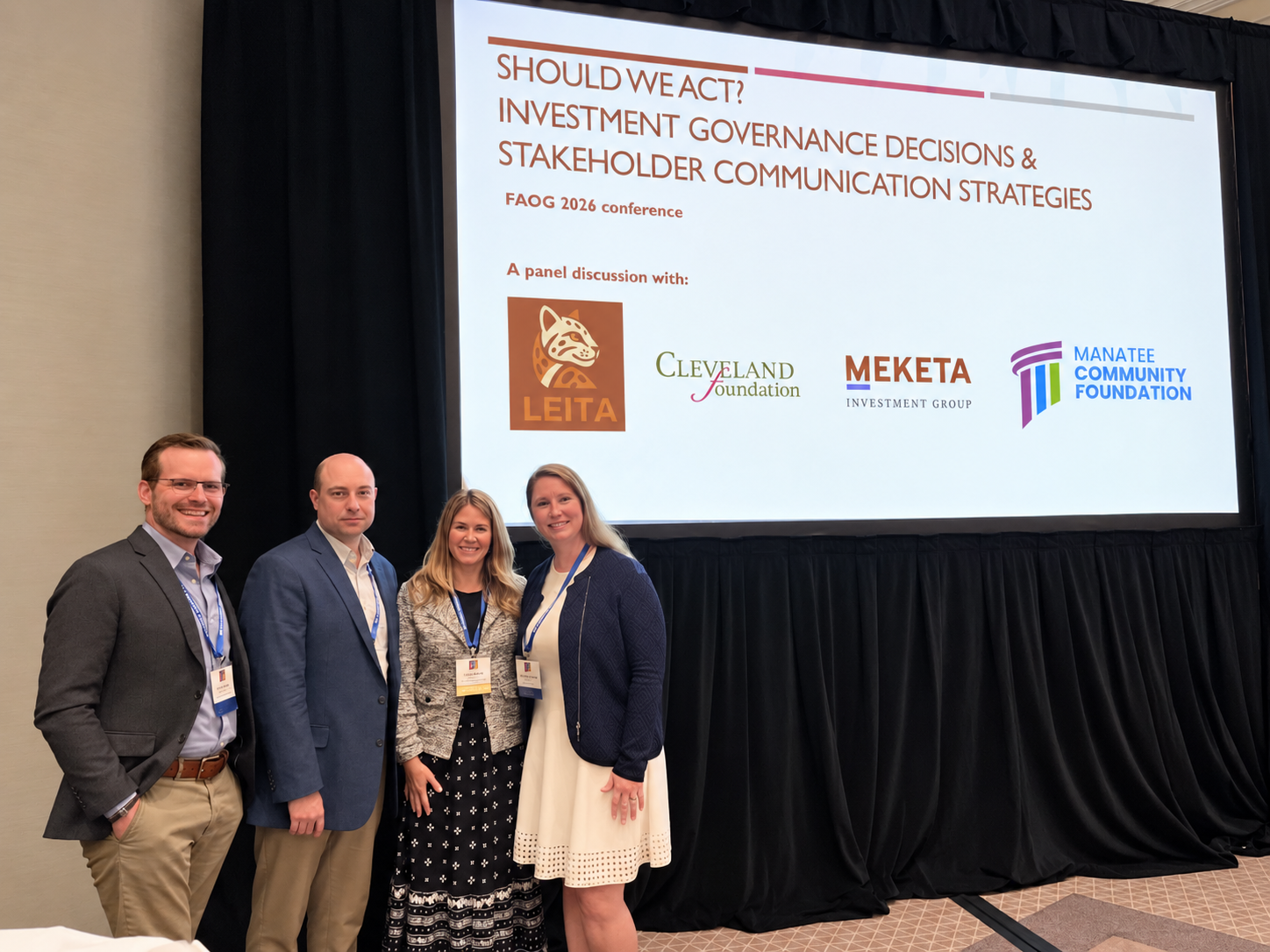
At the FAOG 2026 Annual Conference, Anna Tabke, Founder and President of Leita Advisory, designed and led the session “Should We Act? Investment Governance Decisions & Stakeholder Communication Strategies.” Working with FAOG, she brought together Tony Gattuso of Cleveland Foundation, Jacob Kinsel of Manatee Community Foundation, and Laura Wirick of Meketa Investment Group. Between them, the panel covered an in-house investment team, a newly formed committee working with an OCIO, and the OCIO and search consultant perspectives.
Anna built the session around a situation most committees recognize:
Returns have trailed a simple market benchmark for a few years.
A board member asks why the foundation isn’t just in the S&P 500.
A donor asks why they’re paying for private investments that underperform.
Then someone asks: should we act?
Here are 5 takeaways from the discussion.
Process, process, process. The session’s theme was that governance and portfolio decision-making deserve the same disciplined, repeatable process committees expect from their investment managers. That means clear roles, agreed-upon measures of success, clear reporting, and well-documented decisions. A committee with a sound process can make the call to either act or stay the course. Even more important, it can communicate that decision to boards, donors, and other stakeholders.
Committee makeup matters. The investment committee is a team, and it’s important for its members to work together to make decisions. Laura Wirick noted that individuals without deep investment knowledge can be effective committee members and ask good questions about investment topics. Tony Gattuso said much of his job is managing people. He pays close attention to who chairs the committee and meets with the chair regularly. With clear communication and well-chosen members, a committee can work together to understand, assess, and resolve problems.
The IPS is a living document. Most committees read the Investment Policy Statement when they join and then rarely look at it again. Quarterly meetings tend to focus on the markets instead of the policy. The IPS should be reviewed regularly, since it sets the framework for difficult discussions. Common IPS measures include a long-term objective, a blend of market indices, and sometimes a peer universe. A committee might be focused on performance versus a market index, while the IPS measures returns against a long-term objective of inflation plus spending. Tony cautioned against treating peer rankings like a football rivalry: that kind of competition makes sense in sports but not in investing. Peer data is most useful as a cross-check on the other measures. A committee that keeps its IPS in view has a shared basis for hard conversations and a disciplined way to make long-term portfolio changes.
Educate before performance disappoints. The more context a committee has on how the portfolio is constructed and expected to perform, the more constructive ongoing conversations at quarterly meetings can be. Strong reporting also helps with this; Laura stressed that committees need reporting they can understand, especially when benchmarks disagree. Tony’s team walks the committee through a different asset class each quarter, so members have context when a bad number shows up.
Record why decisions were made. Anna asked how to keep a decision made in 2019 from being relitigated by someone who joined in 2024. Strong onboarding practices, education, and good documentation help here. As an example from the panel, Manatee Community Foundation recently set up its own investment committee. Jacob Kinsel described the chance to document the reasoning behind its first decisions for the members who come later. These conversations are part of the recorded history of the investment portfolio and inform the decisions that follow.



 anna@goleita.com
 678-322-7182
 /goleita