Most investment committees begin an OCIO search with practical questions: How long will it take? Which firms should we invite? How do we compare proposals and conduct finalist interviews? (See our search FAQs for more details.)
But an equally important question often receives less attention: What expertise does the committee need to make this decision well?
The answer determines what you should expect from a search consultant. Some consultants primarily manage the process; others also provide independent judgment and up-to-date knowledge of the OCIO marketplace at each decision point. Both types of assistance are valuable, and a committee should be clear about which one—or both—it needs.
Our earlier piece, The Hidden Cost of a DIY OCIO Search, examined the time and coordination required for a successful process. Here, we focus on the expertise a search consultant brings to the decisions within the search.
What a well-run process gives you
An OCIO search requires significant coordination. Someone must set objectives, assemble the candidate list, draft the request for information, schedule interviews, evaluate proposals, document findings, and support the committee’s deliberations.
This work matters. A disciplined process keeps evaluations consistent, clarifies responsibility at each step, and creates a record the committee can revisit years later.
It also protects the committee’s time. Many members have full-time jobs elsewhere, and an organized search minimizes their burden.
However, process quality and evaluation quality are distinct. Two searches can follow the same steps and use the same scoring template, yet still produce decisions of very different quality. The difference lies in the knowledge and judgment applied at each stage.
The OCIO marketplace changes between your searches
A committee might run an OCIO search only once every 5, 10, or even 15 years. Meanwhile, the provider landscape keeps shifting.
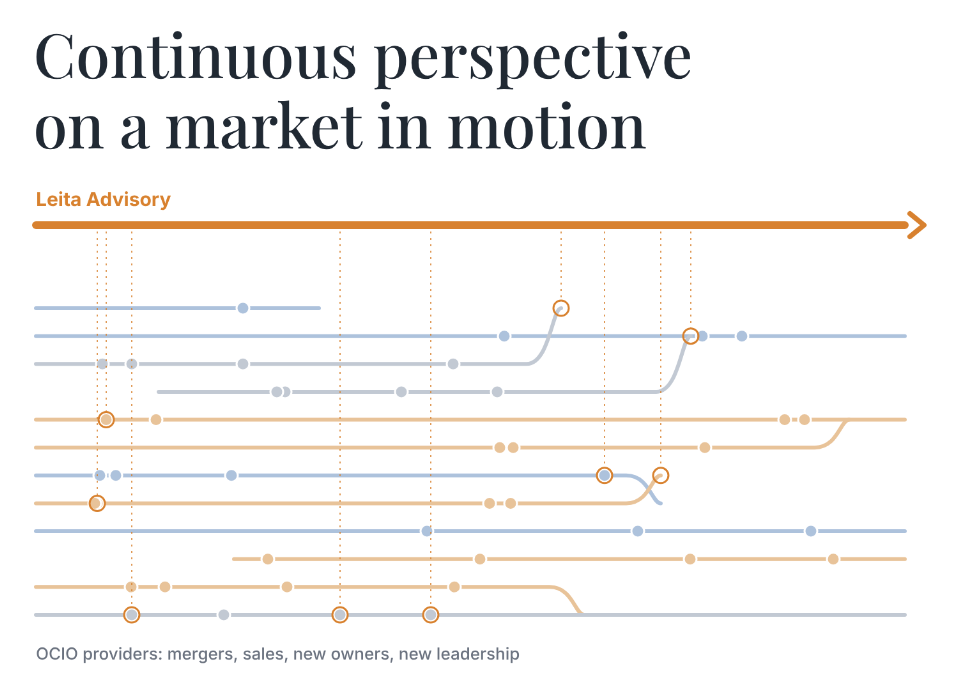
Firms merge or are acquired. Leadership teams turn over. Investment philosophies evolve. Firms add new capabilities, alter portfolio implementation, upgrade technology, and reorganize client service.
A proposal reveals how a firm presents itself today, but rarely explains how it got there: who left, what was acquired, which parts of the platform are new, and which have weathered multiple market cycles. That history helps a committee interpret proposals more accurately.
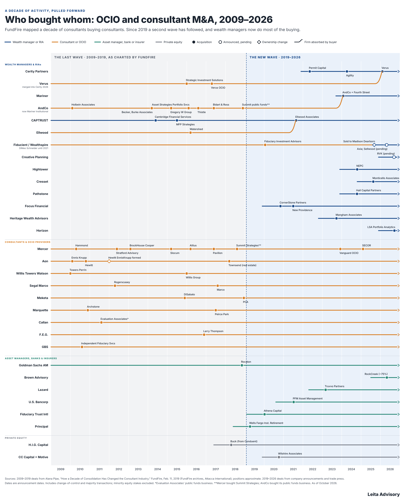
In February 2019, FundFire mapped 10 years of consultant mergers and acquisitions, from January 2009 to February 2019. Falling fee revenue had pushed dozens of firms to sell or combine in search of scale.
Our founder, Anna Dunn Tabke, was quoted in that piece, suggesting that consolidation might not be permanent: "It's more like a pendulum." Within a decade, she suggested, some clients might prefer a smaller firm where they matter more as a client.
A second wave of consolidation has followed, now reaching deep into the OCIO market. The buyers have changed as well: wealth managers and private equity-backed advisory firms now drive much of the activity. Cerity Partners bought Agility from Perella Weinberg in 2024 and agreed to merge with Verus in 2026. Hightower took a majority stake in NEPC. Cresset combined with Monticello Associates. In 2026 alone, Brown Advisory invested in RockCreek, and Creative Planning agreed to buy RVK. We expect at least one more deal before year-end.
For a committee, the critical question is what these changes mean for the service it receives and the investment opportunities its OCIO can access. When ownership, leadership, scale, or structure shifts, a firm's delivery of advice and investment services can shift as well. A provider's current capabilities matter—but so does the path it took to build them. (Curious to learn more? See our piece, Your OCIO Got Acquired? Next Steps for Fiduciaries.)
OCIO and Consultant M&A from 2009-2026
Following the market continuously
Someone who spends most of the year actively tracking OCIO providers sees the market very differently from someone who only engages with it when a client initiates a search.
Leita’s knowledge is built on frequent, in-depth conversations with providers; ongoing due diligence; tracking organizational changes; automated monitoring of Form ADVs and other firm filings; and years of experience working with institutions. This approach builds pattern recognition. We have direct experience discerning which changes at a firm truly matter and understanding the tradeoffs driven by OCIO go-to-market strategies.
Leita meets with several OCIO providers every week, combining formal due diligence with informal conversations. We maintain completed due diligence questionnaires on 70 OCIO providers and preliminary data on many more.
Between searches, we continually update each provider’s due diligence questionnaire, Form ADV data, fee and performance data, and market positioning. We track departures and other organizational changes both formally, through DDQs and RFP responses, and informally, through ongoing conversations. Our founder knows many senior leaders at OCIO firms, and when something changes, she often hears about it firsthand.
Where judgment matters most
Many OCIO providers offer institutional experience, credible investment teams, and established processes. The real challenge is choosing among capable firms whose strengths differ in meaningful ways.
An experienced OCIO search firm helps a committee navigate nuanced questions such as:
How does the firm's investment philosophy show up in actual portfolio construction and implementation?
How well does its approach fit the institution's governance structure and the way the committee likes to make decisions?
Which operational capabilities matter for this institution's circumstances?
How could changes in ownership, leadership or organization affect the relationship?
Which differences among the finalists are real, and which are differences in presentation?
What is the committee giving up when it prefers one provider over another?
A scoring framework keeps the comparison consistent. But answering these questions also requires context, informed interpretation, and an advisor willing to say, "We need to find out more," when the evidence is thin.
Here's an example from the field:
One foundation began its OCIO search independently. Staff sent a preliminary information request to a list of firms and started scoring the responses. Partway through, they realized they needed additional expertise and reached out to our founder for help.
The foundation invests with a strong equity lens and wanted to consider OCIO firms that shared that perspective. Its list missed one of the strongest boutiques in the market, a firm with diverse ownership. We preserved the foundation’s previous work, added the missing firm, and evaluated it alongside the others. It reached the finals.
That firm did not win the mandate. Still, the committee chose from a complete set of finalists that matched its priorities—and could clearly explain why it selected the winner over another firm it had every reason to consider.
Good search advice starts before the RFP
An institution’s objectives, governance structure, liquidity needs, operational resources, and appetite for delegation should guide the search from the outset. An experienced advisor helps clarify which differences between providers truly matter for the institution’s unique situation—long before anyone drafts a candidate list.
Leita is often asked how we narrow the field from 100 OCIO providers to a shortlist of candidates. For us, this step is straightforward because it is grounded in a deep understanding of each client’s needs and priorities, and how OCIO firms’ strengths and tradeoffs align with them. No OCIO is perfect, but our industry sperspective helps committees understand how different providers fit their specific goals.
Independence and specialization
These are distinct qualities that set top OCIO search firms apart—and both are essential.
At Leita, independence is fundamental. We have no competing interests or outside revenue sources. Our priorities are fully aligned with our clients—not with the OCIOs seeking their business. We believe independence from conflict is the single most important characteristic an OCIO search firm can offer.
Specialization is about how the OCIO search consultant builds and keeps the expertise the work requires. Leita focuses exclusively on OCIO search, with no other lines of business to distract from our laser focus on matching institutions with the best OCIOs.
Know what you're buying
Institutions require varying levels of support from an OCIO search provider. Some primarily need project management; others face complex governance, investment, operational, or relationship questions and benefit greatly from having an experienced advisor by their side.
When comparing search consultants, consider the scope and substance of their work alongside their fees—so your committee receives the support it needs to make a confident, lasting investment partnership decision.
Questions to ask a prospective search consultant
How do you keep up with the OCIO marketplace between client searches?
How do you spot and evaluate changes in a provider's organization, investment approach or operating model?
How does your experience affect which firms you suggest we consider?
How do you weigh governance and operational capability alongside investment capability?
Who will personally do the evaluation and advise our committee?
What other business lines, compensation arrangements or relationships with OCIOs do your firm or affiliates have?
Can you give an example of a search where your judgment changed its direction or outcome?
Make a 10+ year decision
A committee may conduct an OCIO search only occasionally, but the outcome can shape its investment program and governance relationships for a decade or longer.
A successful search delivers more than just a selected provider. The committee should understand the alternatives, the tradeoffs, and the rationale for its choice—well enough to explain the decision and implement it with confidence. Our clients are prepared for a seamless operational transition, with a committee poised to begin important strategic investment work from Day 1.
A search with Leita lasts several months, but the knowledge and perspective we bring to the OCIO market has been built over decades.
Anna Dunn Tabke, CFA, CAIA, is the founder of Leita Advisory, an independent OCIO search consultant, and has personally led more than 100 institutional OCIO searches.
 Back



 anna@goleita.com
 678-322-7182
 Leita Advisory on LinkedIn